Redox

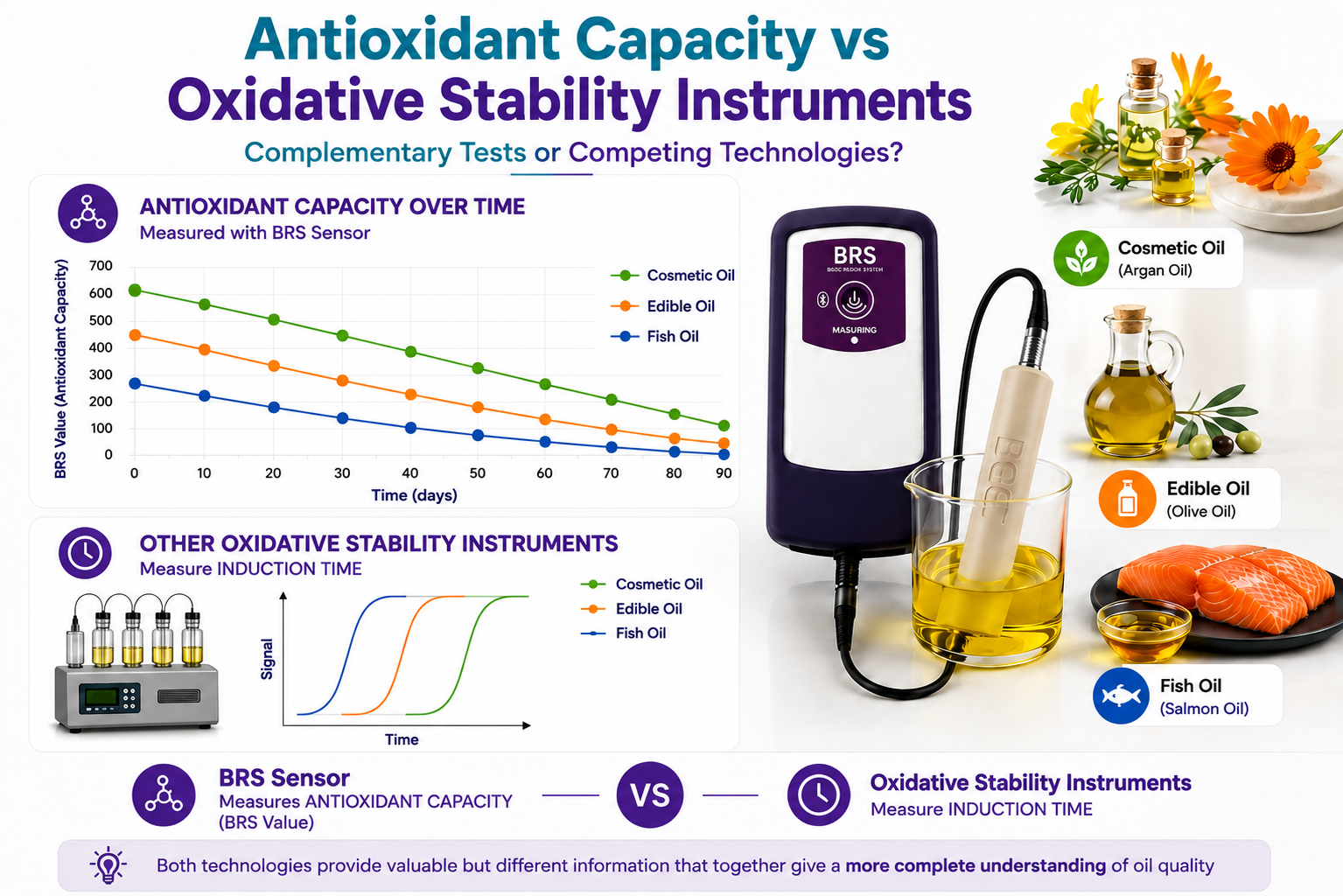
BRS Sensor vs. Oxidative Stability Instruments: Competing Technologies or Complementary Tools?

When assessing the quality and shelf life of oils and fats, oxidative stability is one of the most important parameters to consider. Traditionally, laboratories have relied on accelerated oxidation instruments to evaluate an oil’s resistance to oxidation. With the introduction of innovative technologies such as the BRS Sensor, a common question arises: Is the BRS Sensor

2026-07-07T10:50:44+02:00July 7th, 2026|Devices, Samples|0 Comments

Choose the right antioxidant capacity method

Selecting the most appropriate antioxidant capacity assay is a key step for obtaining reliable and meaningful results, since antioxidant compounds differ in structure, polarity, and reaction mechanisms. Antioxidant capacity assays are mainly based on three reaction mechanisms: Electron Transfer (ET)-based methods, such as FRAP, Folin-Ciocalteu, CUPRAC and BRS, which evaluate reducing power. Hydrogen Atom Transfer

2026-06-03T12:20:06+02:00June 3rd, 2026|Devices, Kits, Samples|0 Comments
Go to Top