antioxidant

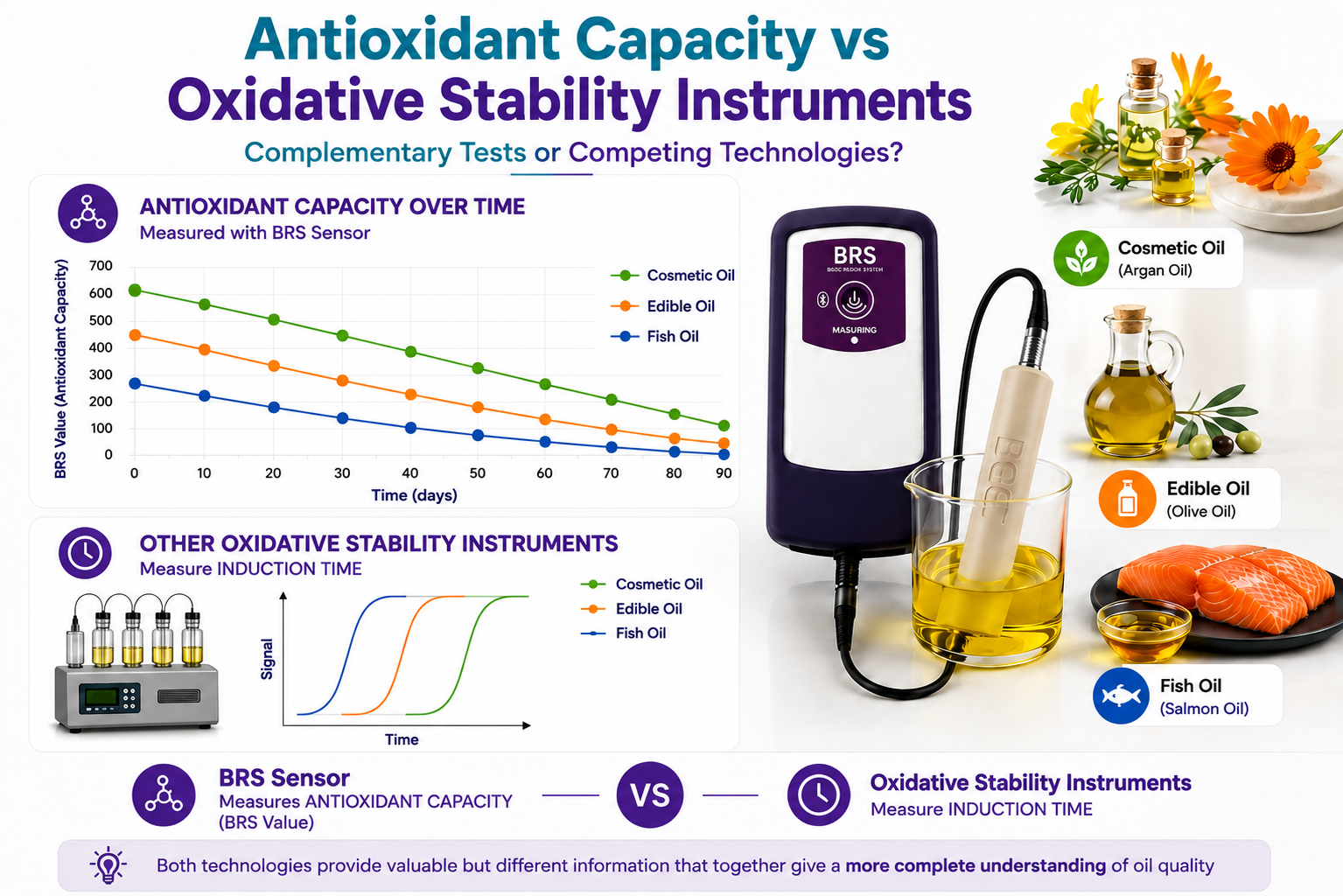
BRS Sensor vs. Oxidative Stability Instruments: Competing Technologies or Complementary Tools?

When assessing the quality and shelf life of oils and fats, oxidative stability is one of the most important parameters to consider. Traditionally, laboratories have relied on accelerated oxidation instruments to evaluate an oil’s resistance to oxidation. With the introduction of innovative technologies such as the BRS Sensor, a common question arises: Is the BRS Sensor

2026-07-07T10:50:44+02:00July 7th, 2026|Devices, Samples|0 Comments

Choose the right antioxidant capacity method

Selecting the most appropriate antioxidant capacity assay is a key step for obtaining reliable and meaningful results, since antioxidant compounds differ in structure, polarity, and reaction mechanisms. Antioxidant capacity assays are mainly based on three reaction mechanisms: Electron Transfer (ET)-based methods, such as FRAP, Folin-Ciocalteu, CUPRAC and BRS, which evaluate reducing power. Hydrogen Atom Transfer

2026-06-03T12:20:06+02:00June 3rd, 2026|Devices, Kits, Samples|0 Comments

Plants Antioxidant Potential

Why do all plants have antioxidant potential? Plants have an innate ability to biosynthesize a wide range of antioxidants capable of attenuating Reactive oxygen species (ROS) induced oxidative damage Plants. Most of the time, the production of free radicals is genetically planned since they function as signaling molecules. However, overproduction of free radicals can

2021-10-04T17:20:01+02:00December 16th, 2020|Devices, News|0 Comments

The antioxidant capacity of lemon

The antioxidant capacity of lemon - 9 November 2020 Lemon is a worldwide consumed citric with huge antioxidant potential. But do you think you know all about this fruit? Check our blog if you want to discover lemon’s great potential to solve current problems in a wide range of different fields, from health, to

2021-10-04T15:28:17+02:00November 9th, 2020|News|0 Comments
Go to Top