
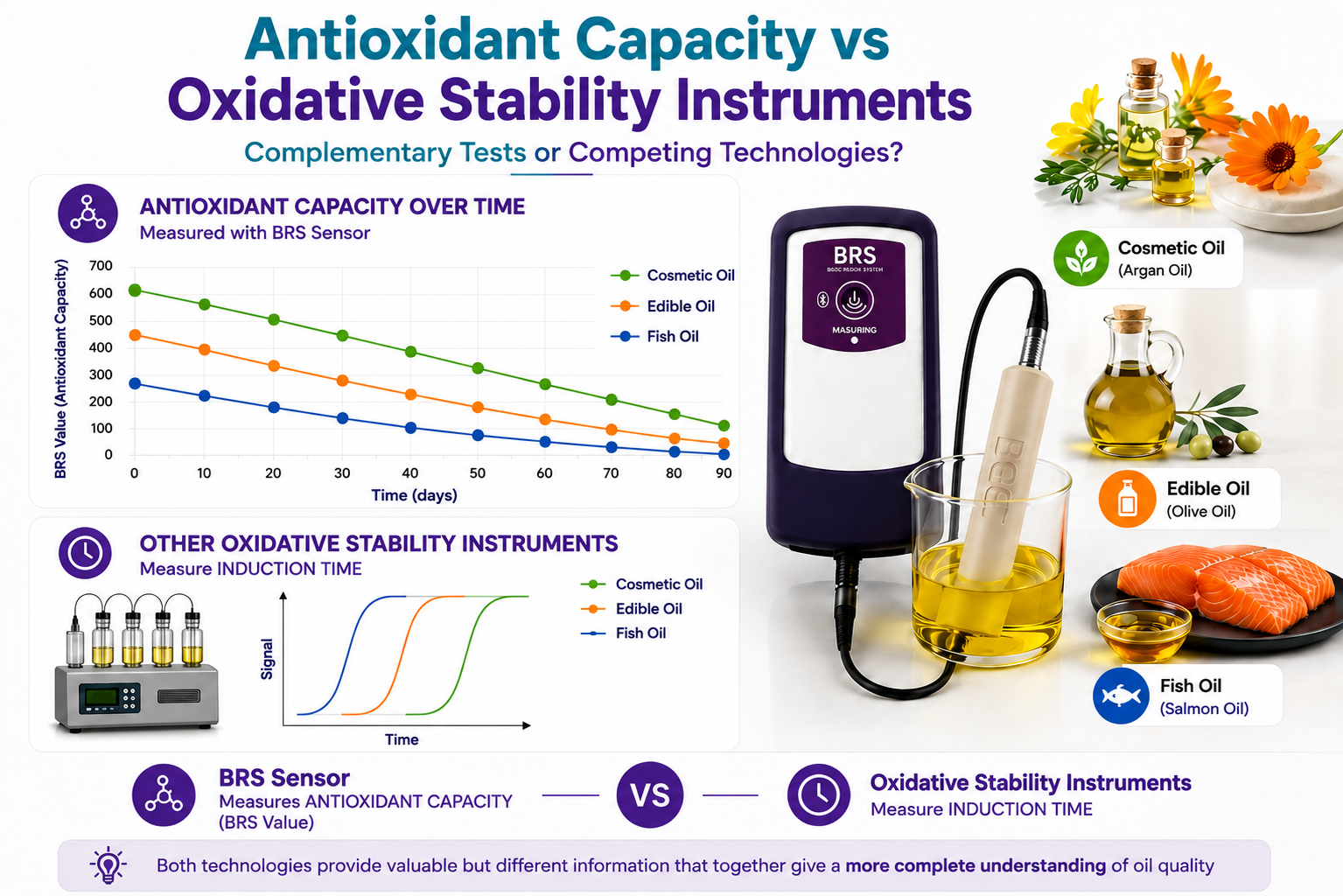
When assessing the quality and shelf life of oils and fats, oxidative stability is one of the most important parameters to consider. Traditionally, laboratories have relied on accelerated oxidation instruments to evaluate an oil’s resistance to oxidation.
With the introduction of innovative technologies such as the BRS Sensor, a common question arises: Is the BRS Sensor also an alternative to oxidative stability instruments?
The answer is simple: they measure different but highly complementary parameters.
Accelerated Oxidation: oxidative stability Tests
Traditional oxidative stability methods are accelerated oxidation tests designed to determine how resistant an oil is to oxidation under forced conditions, typically involving elevated temperatures and continuous airflow. The result is generally expressed as an induction time, which is often used as an indicator of shelf life.
These methods are widely accepted in the industry and are frequently required for regulatory compliance or product validation. However, because they rely on extreme testing conditions, they do not necessarily reflect the actual oxidation processes occurring during normal storage and use.
Essentially, oxidative stability instruments answer the question: “How resistant is this oil to oxidation under accelerated conditions?”
What Does the BRS Sensor Measure?
The BRS Sensor takes a different approach. Using an electrochemical technique based on voltammetry, it measures the Total Antioxidant Capacity (TAC) of oils and fats, providing results in terms of antioxidant equivalents (such as tocopherol equivalents) or as BRS Value.
Rather than measuring how long an oil resists oxidation, the BRS Sensor evaluates its current antioxidant potential and redox status.
This distinction is important because antioxidants are one of the primary factors influencing oxidative stability. Whether naturally present or intentionally added, antioxidants protect oils from oxidation and are gradually consumed during this process.
As a result, antioxidant capacity can serve as a valuable marker of oxidative stability and product quality.
Antioxidant Capacity as an Indicator of Oil Quality
The concept is not entirely new. An electrochemical device for the determination of the remaining useful life of industrial oils based on antioxidant capacity measurements is commercially available. This instrument calculates the Remaining Useful Life by comparing the antioxidant concentration of an in-use oil sample against the antioxidant concentration of a fresh, baseline sample.
Similarly, the BRS Sensor enables users to monitor changes in antioxidant capacity over time, providing valuable information about oil degradation before severe oxidation becomes apparent.
Why Use the BRS Sensor?
One of the greatest advantages of the BRS Sensor is its speed and practicality.
Compared with traditional oxidative stability tests, the BRS Sensor offers:
 These characteristics make it particularly useful for routine quality control and process monitoring.
Applications Across the Oil Industry
Users have found the BRS Sensor especially valuable for:

To summarize
- Oxidative stability methods remain highly valuable for shelf-life estimation and regulatory validation, while the BRS Sensor provides a rapid and sensitive way to monitor the antioxidant status of oils throughout their lifecycle. By combining both approaches, manufacturers gain a more complete understanding of product quality, oxidation behavior, and antioxidant protection.
- Rather than competing with traditional oxidative stability instruments, the BRS Sensor adds an additional source of information that helps users make faster and more informed decisions about their oils and fats.
Contact us to learn more about our antioxidant analysis solutions at support@bqcredox.com. We are here to help you!
Discover our BRS Devices to find the most suitable solution for your analysis.


